Posts

Showing posts with the label bits

Understanding File Systems

Image
Understanding File Systems in this computer not only computes data but also stores data. The issue of file structure and  data storage  is of prime concern. To solve this issue, manufacturers employ an effective storing and organization of the data on the computer called as a file system. The file system makes it easy to find and access the data. Data storage devices like hard disks or CD-ROMs can use the file system to store the data. The file system divides the file into smaller pieces and then stores them to  hard disks  or flash memory in clusters. A file system is a set of data types employed for: Storage Hierarchical categorization Management Navigation Access Recovering the data Major file systems include FAT, NTFS, HFS, Ext2, Ext3, etc. Users can access the files using the graphical user interfaces or command line user interfaces. File systems organize the data in the form of tree-structured directories. These are generally file cabinets and folders. Director...

Understanding Bit, Nibble and Byte

Image
  Understanding Bit, Nibble and Byte in this article explained  Bit , Nibble and Byte Data storage format of  hard disk  with how to calculate it. Bit A bit, short for binary digit is the smallest unit of data or basic information unit in  computing  and digital communications. It can contain only one of the two values represented as 0 or 1. They also represent logical values such as true/false, yes/no, activation states (on/off), algebraic signs (+/-) or any other two-valued attribute. Byte A byte, short for binary term is a digital information unit of  data  that consists of eight bits. The byte is representation of the number of bits a system has used to encode one text character. Therefore, it is the smallest addressable memory unit in many computer architectures. Two hexadecimal digits represent a full byte or octet. Nibble A nibble, also known as half-byte or tetrade is a collection of four bits or half of an octet in computing. Common repre...

Logical & Physical Structure of a Hard Disk

Image
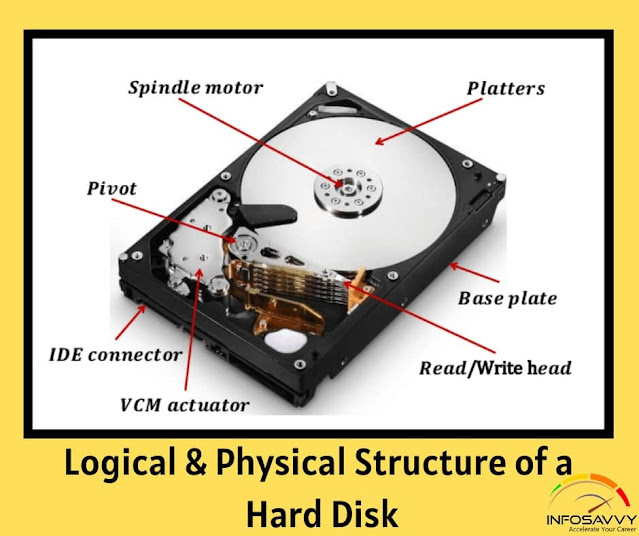
   In this article explain Logical & Physical Structure of a Hard Disk there components uses. Physical Structure of a Hard Disk The main components of hard disk drive are: Platters:  These are disk like structures present on the hard disk, stacked one above the other and store the data Head:   It is a device present on the arm of the hard drive that reads or writes data on the magnetic platters, mounted on the surface of the drive Spindle:  It is the spinning shaft on which holds the platters in a fixed position such that it is feasible for the read/write arms to get the data on the disks Actuator:  It is a device, consisting of the read-write head that moves over the hard disk con to save or retrieve information Cylinder These are the circular tracks present on the platters of the disk drive at equal distances from the center Related Product :  Computer Hacking Forensic Investigator | CHFI Physical Structure of a Hard Disk (Cont’d) A hard disk con...